
If you’ve spent any time in AL development, you’ve probably reinvented a wheel or two. Written a quick parser for a date string, wrestled with URL encoding for an API call, or built a little helper to compare dates safely. The "Type Helper" Codeunit (ID 10, namespace System.Reflection) exists specifically to handle this kind of utility work—and it’s surprisingly comprehensive.
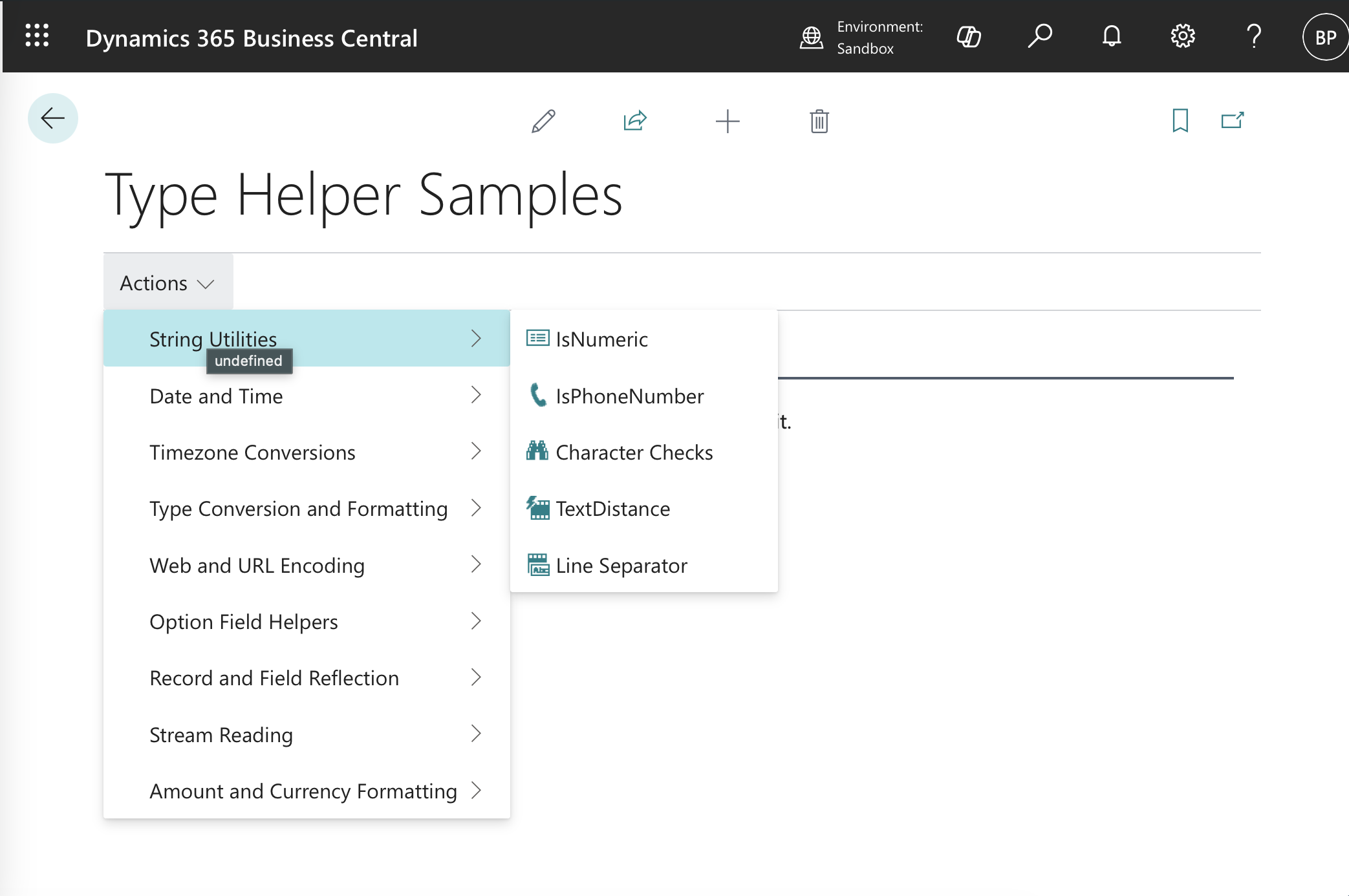
This post walks through useful procedures grouped by category, with practical AL examples for each.
You can find the full code for the example on GitHub.
What Is the Type Helper Codeunit?
"Type Helper" is a base application Codeunit that provides a broad set of utility methods covering:
- String and character checks
- Date, time, and timezone formatting and conversion
- URL/HTML encoding
- Record and field reflection
- Option field helpers
- Stream reading
- Amount/currency format strings
It’s not flashy, but it saves real time. Before writing your own utility procedure, check here first.
String Utilities
IsNumeric
procedure IsNumeric(Text: Text): Boolean
Returns true if a text value can be parsed as a Decimal.
var
    TypeHelper: Codeunit "Type Helper";
    Result1, Result2: Boolean;
    Value1, Value2: Text;
begin
    Value1 := '42.5';
    Value2 := 'hello';

    Result1 := TypeHelper.IsNumeric(Value1);   // true
    Result2 := TypeHelper.IsNumeric(Value2);  // false
    Message('IsNumeric(''' + Value1 + '''): %1\IsNumeric(''' + Value2 + '''): %2', Result1, Result2);
end;
Useful for validating user input or imported data before calling Evaluate.
IsPhoneNumber
procedure IsPhoneNumber(Input: Text): Boolean
Validates that a string contains only digits, spaces, parentheses, dashes, and +. It uses a regex under the hood.
var
    TypeHelper: Codeunit "Type Helper";
    Value1, Value2: Text;
begin
    Value1 := '+1 (555) 123-4567';
    Value2 := 'not-a-phone';

    Message('IsPhoneNumber(''' + Value1 + '''): %1\IsPhoneNumber(''' + Value2 + '''): %2',
        TypeHelper.IsPhoneNumber(Value1), TypeHelper.IsPhoneNumber(Value2));
end;
IsLatinLetter / IsDigit / IsUpper
procedure IsLatinLetter(ch: Char): Boolean
procedure IsDigit(ch: Char): Boolean
procedure IsUpper(ch: Char): Boolean
Character-level checks. Handy when parsing text character by character.
var
    TypeHelper: Codeunit "Type Helper";
    ch: Char;
begin
    ch := 'A';
    if TypeHelper.IsLatinLetter(ch) then
        Message('It is a letter.');

    ch := '3';
    if TypeHelper.IsDigit(ch) then
        Message('It is a digit.');
end;
TextDistance
procedure TextDistance(Text1: Text; Text2: Text): Integer
Calculates the Levenshtein distance (I didn’t know what this was before digging into this Codeunit) between two strings—the minimum number of single-character edits to get from one string to the other. Useful for fuzzy matching or detecting near-duplicates.
var
    TypeHelper: Codeunit "Type Helper";
    Distance: Integer;
begin
    Distance := TypeHelper.TextDistance('Business', 'Busines');  // 1
    Distance := TypeHelper.TextDistance('Hello', 'World');       // 4
end;
Note: Strings are limited to ~1024 characters.
NewLine / CRLFSeparator / LFSeparator
procedure NewLine(): Text
procedure CRLFSeparator(): Text[2]
procedure LFSeparator(): Text[1]
Returns the system newline string, a carriage-return + line-feed pair, or just a line feed. Avoid hardcoding character codes.
var
    TypeHelper: Codeunit "Type Helper";
    Msg: Text;
begin
    Msg := 'Line one' + TypeHelper.CRLFSeparator() + 'Line two';
    Message(Msg);
end;
Date and Time
FormatDateWithCurrentCulture
procedure FormatDateWithCurrentCulture(DateToFormat: Date): Text
The simplest way to format a Date using the current user’s locale. Great for displaying dates in messages or reports.
var
    TypeHelper: Codeunit "Type Helper";
    FormattedDate: Text;
begin
    FormattedDate := TypeHelper.FormatDateWithCurrentCulture(WorkDate());
    Message(FormattedDate);
end;
FormatDate (overloads)
procedure FormatDate(DateToFormat: Date; LanguageId: Integer): Text
procedure FormatDate(DateToFormat: Date; Format: Text; CultureName: Text): Text
Two overloads let you format with a specific language ID or a custom format string and culture name.
var
    TypeHelper: Codeunit "Type Helper";
begin
    // Format using a language ID (e.g., 1033 = en-US)
    Message(TypeHelper.FormatDate(WorkDate(), 1033));

    // Format using a .NET format string and culture name
    Message(TypeHelper.FormatDate(WorkDate(), 'MMMM dd, yyyy', 'en-US'));
end;
CompareDateTime
procedure CompareDateTime(DateTimeA: DateTime; DateTimeB: DateTime): Integer
Compares two DateTime values with a built-in millisecond-level tolerance that accounts for SQL precision rounding. Returns 1, 0, or -1.
var
    TypeHelper: Codeunit "Type Helper";
    StartDateTime: DateTime;
    EndDateTime: DateTime;
    Result: Integer;
begin
    StartDateTime := CreateDateTime(WorkDate(), 080000T);
    EndDateTime := CreateDateTime(WorkDate(), 170000T);

    Result := TypeHelper.CompareDateTime(StartDateTime, EndDateTime);
    Message('CompareDateTime result: %1 (negative means first is earlier)', Result);
end;
Don’t compare DateTime values directly with = when they come from the database—use this instead.
AddHoursToDateTime
procedure AddHoursToDateTime(SourceDateTime: DateTime; NoOfHours: Integer): DateTime
Adds a number of hours to a DateTime value.
var
    TypeHelper: Codeunit "Type Helper";
    NewDT: DateTime;
begin
    NewDT := TypeHelper.AddHoursToDateTime(CurrentDateTime, 8);
end;
GetHMSFromTime
procedure GetHMSFromTime(var Hour: Integer; var Minute: Integer; var Second: Integer; TimeSource: Time)
Breaks a Time value into its hour, minute, and second components.
var
    TypeHelper: Codeunit "Type Helper";
    H: Integer;
    M: Integer;
    S: Integer;
    CurrentTime: Time;
begin
    CurrentTime := Time;
    TypeHelper.GetHMSFromTime(H, M, S, CurrentTime);
    Message('Current time -> H:%1 M:%2 S:%3', H, M, S);
end;
EvaluateUnixTimestamp
procedure EvaluateUnixTimestamp(Timestamp: BigInteger): DateTime
Converts a Unix epoch timestamp (BigInteger, seconds since Jan 1 1970) to a DateTime, adjusting for the user’s timezone offset.
var
    TypeHelper: Codeunit "Type Helper";
    ResultDT: DateTime;
    TimeStamp: BigInteger;
begin
    TimeStamp := 1740657600;
    ResultDT := TypeHelper.EvaluateUnixTimestamp(TimeStamp);
    Message('EvaluateUnixTimestamp(' + Format(TimeStamp, 9) + '): %1', ResultDT);
end;
GetCurrUTCDateTime / GetCurrUTCDateTimeAsText / GetCurrUTCDateTimeISO8601
procedure GetCurrUTCDateTime(): DateTime
procedure GetCurrUTCDateTimeAsText(): Text
procedure GetCurrUTCDateTimeISO8601(): Text
Three shortcuts for getting the current UTC time in different formats.
var
    TypeHelper: Codeunit "Type Helper";
begin
    // DateTime value
    MyDT := TypeHelper.GetCurrUTCDateTime();

    // RFC 1123 text: "Thu, 27 Feb 2026 14:30:00 GMT"
    MyText := TypeHelper.GetCurrUTCDateTimeAsText();

    // ISO 8601: "2026-02-27T14:30:00Z"
    MyText := TypeHelper.GetCurrUTCDateTimeISO8601();
end;
GetCurrUTCDateTimeISO8601 is especially useful when building API payloads.
Timezone Conversions
GetUserTimezoneOffset
procedure GetUserTimezoneOffset(var Duration: Duration): Boolean
Returns the current user’s UTC offset as a Duration. Returns false if the user has no timezone set.
var
    TypeHelper: Codeunit "Type Helper";
    Offset: Duration;
begin
    if TypeHelper.GetUserTimezoneOffset(Offset) then
        Message('Offset in ms: %1', Offset);
end;
Type Conversion and Formatting
Evaluate
procedure Evaluate(var Variable: Variant; String: Text; Format: Text; CultureName: Text): Boolean
The general-purpose type evaluator. Pass in a Variant of the target type, a text string, an optional format, and an optional culture name.
var
    TypeHelper: Codeunit "Type Helper";
    Value: Variant;
    ParsedDate: Date;
    Ok: Boolean;
begin
    ParsedDate := 0D;
    Value := ParsedDate;
    Ok := TypeHelper.Evaluate(Value, '02/27/2026', 'MM/dd/yyyy', 'en-US');
    if Ok then
        ParsedDate := Value;
end;
FormatDecimal
procedure FormatDecimal(Decimal: Decimal; DataFormat: Text; DataFormattingCulture: Text): Text
Formats a Decimal with a .NET format string and culture name. Useful for building API payloads or localized output.
var
    TypeHelper: Codeunit "Type Helper";
    Formatted: Text;
begin
    Formatted := TypeHelper.FormatDecimal(1234.56, 'N2', 'en-US');  // "1,234.56"
    Formatted := TypeHelper.FormatDecimal(1234.56, 'N2', 'de-DE');  // "1.234,56"
end;
IntToHex
procedure IntToHex(IntValue: Integer): Text
Converts an integer to its hexadecimal representation.
var
    TypeHelper: Codeunit "Type Helper";
begin
    Message(TypeHelper.IntToHex(255));   // "FF"
    Message(TypeHelper.IntToHex(4096));  // "1000"
end;
Maximum / Minimum
procedure Maximum(Value1: Decimal; Value2: Decimal): Decimal
procedure Minimum(Value1: Decimal; Value2: Decimal): Decimal
Returns the larger or smaller of two Decimal values.
var
    TypeHelper: Codeunit "Type Helper";
begin
    Message('%1', TypeHelper.Maximum(10.0, 25.5));  // 25.5
    Message('%1', TypeHelper.Minimum(10.0, 25.5));  // 10
end;
Web and URL Encoding
These are essential any time you’re calling external APIs or generating web links in AL.
UrlEncode / UrlDecode
procedure UrlEncode(var Value: Text): Text
procedure UrlEncode(var Value: SecretText): SecretText
procedure UrlDecode(var Value: Text): Text
var
    TypeHelper: Codeunit "Type Helper";
    Encoded: Text;
begin
    Encoded := 'search term with spaces';
    TypeHelper.UrlEncode(Encoded);
    Message(Encoded);  // "search+term+with+spaces"
end;
There’s also an overload that accepts and returns SecretText for encoding credentials without exposing the raw value.
HtmlEncode / HtmlDecode
procedure HtmlEncode(var Value: Text): Text
procedure HtmlDecode(var Value: Text): Text
Encodes characters like <, >, & for safe HTML output, or decodes them back.
var
TypeHelper: Codeunit "Type Helper";
SafeHtml: Text;
begin
SafeHtml := '<script>alert("xss")</script>';
TypeHelper.HtmlEncode(SafeHtml);
Message(SafeHtml); // "<script>alert("xss")</script>"
end;
UriEscapeDataString / UriGetAuthority
procedure UriEscapeDataString(Value: Text): Text
procedure UriGetAuthority(Value: Text): Text
UriEscapeDataString percent-encodes a value (RFC 3986). UriGetAuthority extracts the scheme + host from a URL.
var
    TypeHelper: Codeunit "Type Helper";
begin
    Message(TypeHelper.UriEscapeDataString('hello world'));  // "hello%20world"
    Message(TypeHelper.UriGetAuthority('https://api.example.com/v1/items'));
    // "https://api.example.com"
end;
Option Field Helpers
GetOptionNo
procedure GetOptionNo(Value: Text; OptionString: Text): Integer
Looks up the integer index of an option value string within an option set string. Returns -1 if not found.
var
    TypeHelper: Codeunit "Type Helper";
    Idx: Integer;
begin
    Idx := TypeHelper.GetOptionNo('Posted', 'Open,Released,Posted,Canceled');
    // Returns 2
end;
GetNumberOfOptions
procedure GetNumberOfOptions(OptionString: Text): Integer
Counts how many comma-separated options are in an option string.
var
    TypeHelper: Codeunit "Type Helper";
begin
    Message('%1', TypeHelper.GetNumberOfOptions('Open,Released,Posted'));  // 2 (counts commas)
end;
Watch out: this counts commas, so it returns
n - 1fornoptions. Adjust accordingly.
Record and Field Reflection
GetField / GetFieldLength
procedure GetField(TableNo: Integer; FieldNo: Integer; var Field: Record Field): Boolean
procedure GetFieldLength(TableNo: Integer; FieldNo: Integer): Integer
GetField retrieves field metadata from the Field virtual table and returns false if the field doesn’t exist or is obsolete (ObsoleteState = Removed). GetFieldLength returns the declared length of a text field.
var
    TypeHelper: Codeunit "Type Helper";
    FieldRec: Record Field;
begin
    if TypeHelper.GetField(Database::Customer, Customer.FieldNo(Name), FieldRec) then
        Message('Max length: %1', TypeHelper.GetFieldLength(Database::Customer, Customer.FieldNo(Name)));
end;
SortRecordRef
procedure SortRecordRef(var RecRef: RecordRef; CommaSeparatedFieldsToSort: Text; Ascending: Boolean)
Applies a sort order to a RecordRef using a comma-separated list of field names.
var
    TypeHelper: Codeunit "Type Helper";
    RecRef: RecordRef;
begin
    RecRef.Open(Database::Customer);
    TypeHelper.SortRecordRef(RecRef, '"No."', true);  // ascending by No.
    if RecRef.FindSet() then
        repeat
            // ...
        until RecRef.Next() = 0;
end;
GetKeyAsString
procedure GetKeyAsString(RecordVariant: Variant; KeyIndex: Integer): Text
Returns the key fields of a record as a comma-separated string. Useful for logging or telemetry.
var
    Cust: Record Customer;
    TypeHelper: Codeunit "Type Helper";
    KeyText: Text;
begin
    if Cust.FindFirst() then begin
        KeyText := TypeHelper.GetKeyAsString(Cust, 1);
        Message('GetKeyAsString: %1', KeyText);
    end;
end;
Stream Reading
ReadAsTextWithSeparator / TryReadAsTextWithSeparator
procedure ReadAsTextWithSeparator(InStream: InStream; LineSeparator: Text): Text
[TryFunction]
procedure TryReadAsTextWithSeparator(InStream: InStream; LineSeparator: Text; var Content: Text): Boolean
Reads an InStream into a Text value, using a specified line separator. TryReadAsTextWithSeparator wraps the call in a [TryFunction] for error-safe reading.
var
    TempBlob: Codeunit "Temp Blob";
    TypeHelper: Codeunit "Type Helper";
    FileContent: Text;
    IStream: InStream;
    OStream: OutStream;
begin
    TempBlob.CreateOutStream(OStream);
    OStream.WriteText('Line 1');
    OStream.WriteText(TypeHelper.CRLFSeparator());
    OStream.WriteText('Line 2');
    OStream.WriteText(TypeHelper.CRLFSeparator());
    OStream.WriteText('Line 3');

    TempBlob.CreateInStream(IStream);
    FileContent := TypeHelper.ReadAsTextWithSeparator(IStream, TypeHelper.CRLFSeparator());
    Message('ReadAsTextWithSeparator:\%1', FileContent);
end;
Amount and Currency Formatting
GetAmountFormatLCYWithUserLocale
procedure GetAmountFormatLCYWithUserLocale(): Text
procedure GetAmountFormatLCYWithUserLocale(DecimalPlaces: Integer): Text
Returns a BC format string for displaying amounts in the local currency, formatted for the current user’s locale. Pass an optional decimal places count.
var
    TypeHelper: Codeunit "Type Helper";
    AmtFormat: Text;
begin
    AmtFormat := TypeHelper.GetAmountFormatLCYWithUserLocale();
    Message(Format(1234.56, 0, AmtFormat));
end;
GetXMLAmountFormatWithTwoDecimalPlaces / GetXMLDateFormat
procedure GetXMLAmountFormatWithTwoDecimalPlaces(): Text
procedure GetXMLDateFormat(): Text
Return BC format strings suitable for XML output—two decimal places for amounts, and the standard XML date format.
var
    TypeHelper: Codeunit "Type Helper";
begin
    Message(Format(Today, 0, TypeHelper.GetXMLDateFormat()));        // e.g., "2026-02-27"
    Message(Format(12345.6, 0, TypeHelper.GetXMLAmountFormatWithTwoDecimalPlaces()));  // "12345.60"
end;
Wrapping Up
The "Type Helper" codeunit is one of the most useful utility libraries in BC’s base application—and one of the most underused. Before writing your own string parser, encoding helper, or date workaround, it’s worth skimming the procedure list. There’s a good chance something here already does exactly what you need.
A few things to keep in mind:
LanguageIDToCultureNameandGetCultureNameare obsolete as of v26—Use Codeunit 43Languageinstead.UrlEncodeSecretis obsolete as of v27—Use theSecretTextoverload ofUrlEncodeinstead.
Learn more: Codeunit “Type Helper” – Microsoft Learn
Note: The code and information discussed in this article are for informational and demonstration purposes only. Always test in a sandbox environment before deploying to production. This content was written referencing Microsoft Dynamics 365 Business Central 2025 Wave 2.